Tuesday, 10 May 2016

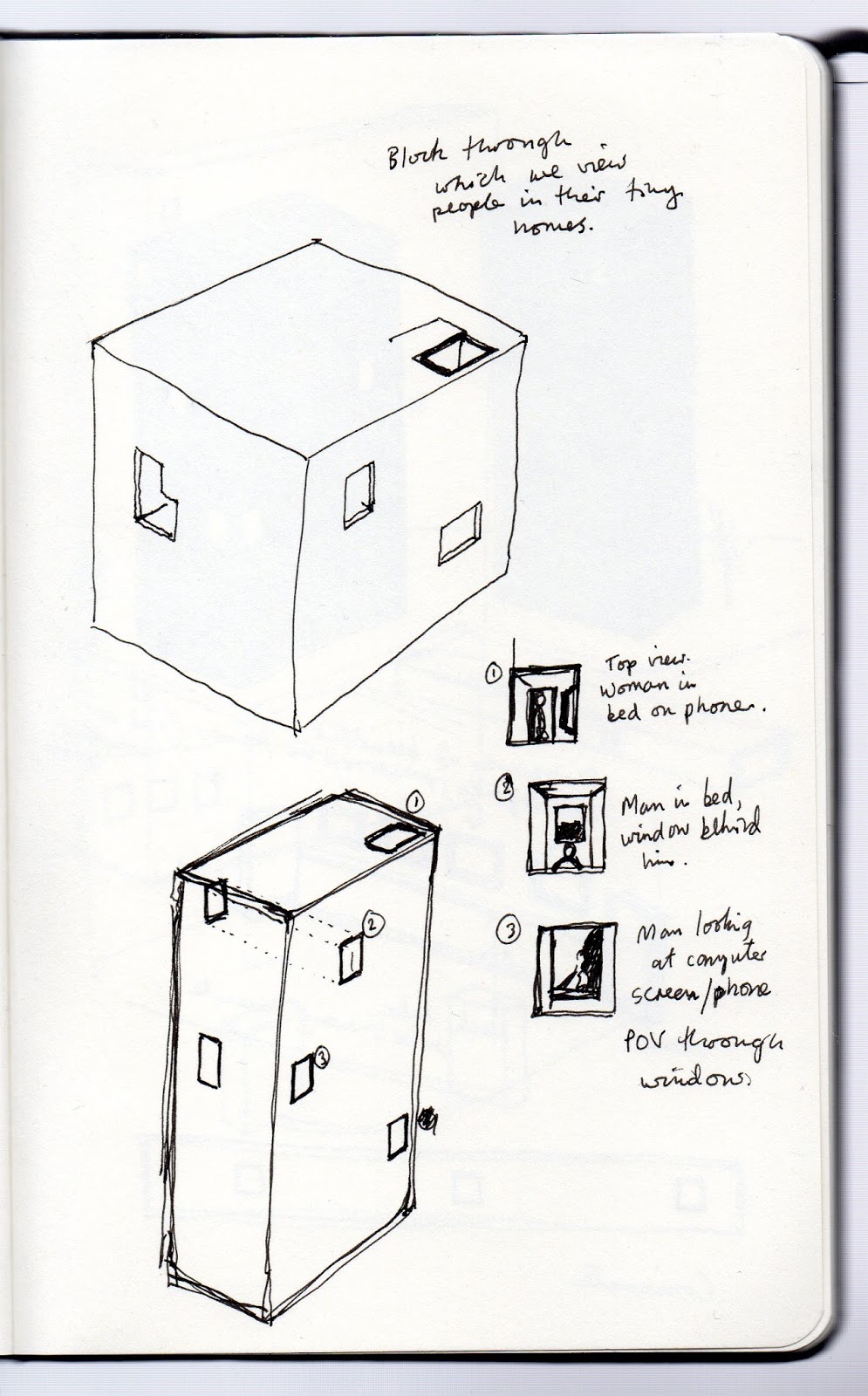
Further sketches for photographic installation


I have returned to the tower block as the setting for my narrative. It is something I can't shake off, yet I am continuing to hold on to the themes of small spaces and isolation which I have explored throughout my creative research and documented in this blog.
Home, place of work, and the commute in between are staples of my evolving idea.
Telephones and coffee are elements which recur when studying and reserching the topic. The phone as means of entertainment as well as communication, making our small spaces seem both smaller and bigger. We can involve ourselves in the internet and films on tiny screens while squeezed up against the window on the tube. We carry our coffees with us and have them on our desks at work as a reminder of the comfort and security of the home which we left behind in the early hours.


Showing lines of communication using thread from windows in the models of flats and offices.

The project is once again coming together with an exhibition in mind. Viewers will participate in a voyeuristic way as well as contemplating their own work/life balance.
 
I have the idea of installing two blocks ('home' and 'work') with a tunnel representing the commute, inbetween. Photos of people inside their small spaces can be viewed through selected apertures or 'windows'. There is an additional idea of presenting larger photographs of the beauty of the outdoors, countryside, hills, forests etc which go by as we travel from one block to the other.

Detailed sketches of how the installation would look when set up in a gallery.

Monday, 9 May 2016

Tower Box

I have the working title 'Tower Box' in mind as it sits well with the form and shape of the box-like blocks containing small windows through which you will be able to view my photographs of box-like rooms.

In order to familiarise myself more with real-life blocks of flats I visited familiar areas of London, particularly the Shepherd's Bush - Holland Park border where I went to school. I always remember the area being flat, with tall structures rising at intermittent distances. Despite sticking out conspicuously into the skyline, they quickly became unnoticeable due to their familiarity and inconspicuous design. They loomed over me like sleeping giants.  


There is also Trellick Tower not so far away and can be seen clearly from the Westway, a location used by JG Ballard in his book 'Concrete Island'. I love Trellick Tower partly for its design but also for the way it acts like a homing device or landmark showing me how to get home. I saw it every day from the kitchen when I worked at the BBC and it made a great impression on me.

Trellick Tower as seen from the Westway. The theme of tower blocks and lines of travel are becoming more apparent in my work and ideas. 


Sunday, 8 May 2016

Michael Wolf's urban landscapes

Having read Kobo Abe's book 'Box Man' about a man who resigns himself to literaly living inside a box, I was drawn to Michael Wolf's series of photos 'The box men of shinjuku station'.

Michael Wolf's collections of urban photography are right up my street. By flattening the depth of field in photos from series' such as 'Architecture of density' and 'Paris rooftops' he highlights just how pressed together homes in urban spaces can be.

From 'The box men of shinjuku station'


From 'Architecture of density'


 From 'Paris rooftops'


The Box Man (2001) Kobo Abe


Wolf, M. (2005 - 2010) Life In Cities. http://photomichaelwolf.com/#

Abe, K. (2001) The Box Man. Vintage Books, London.


Thursday, 5 May 2016

Further progress - Tower Box

My idea is now returning to my original study and reserch into 'tower blocks' or 'high rise' buildings. I am continuing with the theme of isolation and living in small spaces but combining it with the bigger picture of thousands of isolated people living together (an oxymoron, I know, but that is the logic that fascinates me).

Thinking back to the Ai Weiwei exhibition I visited at the Royal Academy, his installation which had the freatest impact on me was the room full of small scale 'cells', replicas of rooms he had been confined and interogated. I was struck my the way he turned us, the audience, into voyeurs, peeking in through hatches to spy on the goings-on inside and in effect turning us into one of the guards. The reduction in scale made this possible, but the realistic rendition of the people and decor of the rooms made our voyeurism more pronounced.

 Ai Weiwei exhibition at the Royal Academy 2015


My plan is to now construct a model tower block, around 4fy high, with a selection of squares cut into them and photographs of rooms inserted. We will be able to view a few different rooms at different angles, for example one room viewed from the top would be like the 'small bedroom' I have already photographed from above.


Thursday, 28 April 2016

Brazil

For my next shoot I took inspiration from photographer Julian Bittencourt and his series In a Window of Prestes Maia 911 Building, which documents the inhabitants of a squatted building in Sao Paulo, Brazil.

I had the idea of trying a shoot which had a more 'exotic' feel, maybe suggesting a location in a warmer climate. My friend who agreed to model for me is Brazilian and I discussed ways of hinting at his hometown in the picture. I wanted to see if I could spread the theme of my project globally, to pose a question which affects people all over the world, not just cities such as London. 

In hindsight I don't find this shoot that successful, and maybe this is because the idea was becoming diluted. I am again slipping into a general view of people living around the world. I will stick to more focused narrative and one location.


Bittencourt, J. (2012) Prestes Maia 22 [Photo]

 Contact sheet for 'Brazil' shoot


Sunday, 24 April 2016

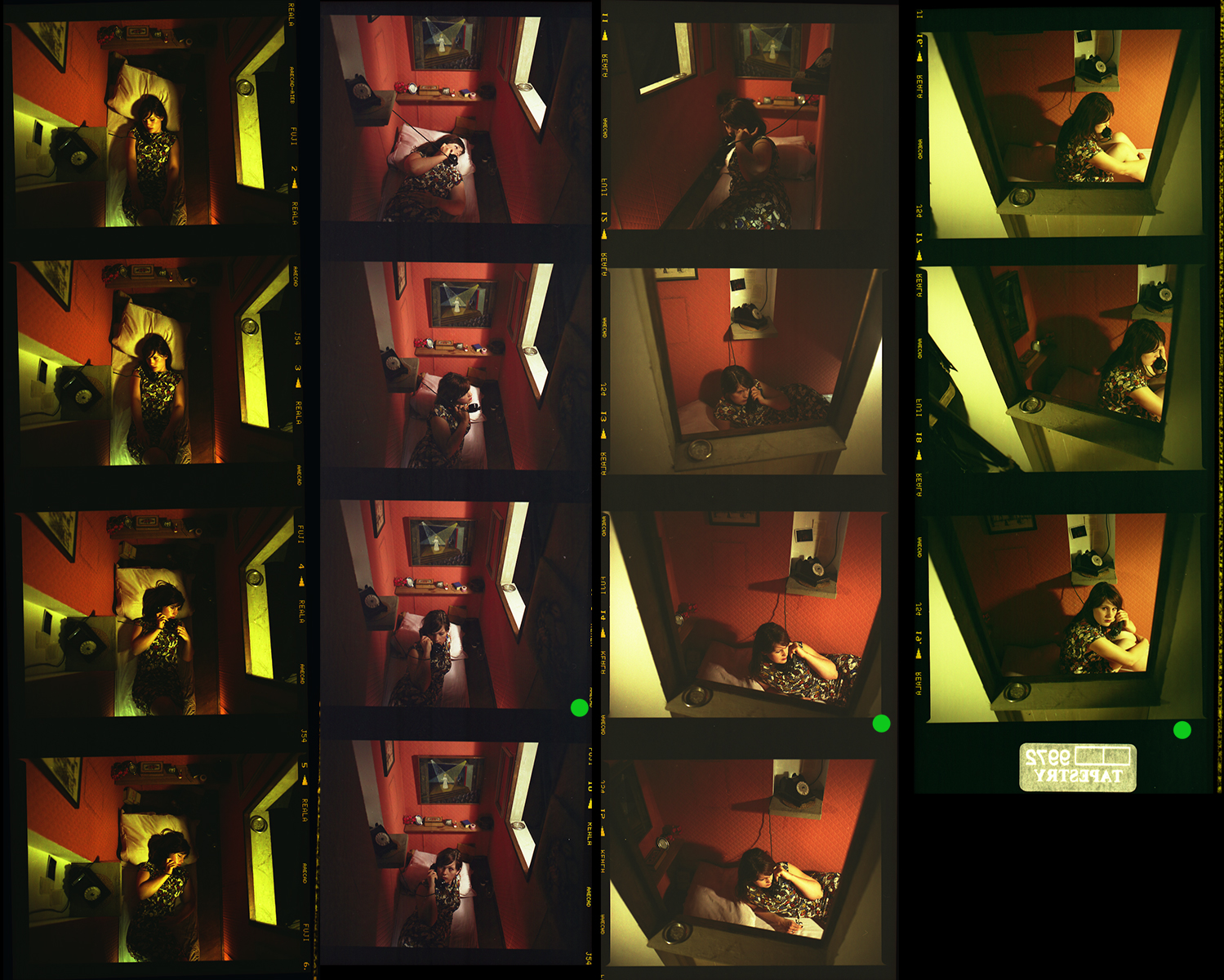
Small room photoshoot

Looking through my early sketches for this project, I came across one I made for a photograph to be taken from above, of an unusually small room with a figure lying on a bed within, looking in the direction of a window. The scale of the room would mean that the bed took up most of the space, with very little extra floor space available. There would be a narrative, in that the person, a woman, would be on the phone, or reading, or staring whistfully out of her window. I initially envisaged it being part of the story of my film, in which a man isolates himself but still attempts to have some sort of relationship, or even love affair using technology. However looking at it now, out of context, I am drawn to the potential stillness of the image, and it's unconventional and slightly voyeuristic point of view. It also has that 'doll's house' element which I picked up on earlier with the example of Wes Anderson's explicit breaking down of the 'fourth wall'.

I followed up this idea and made a set in my friend's workshop (he is a carpenter) using mostly recycled materials and freestanding wall units which he makes as part of his business. For the decor and props I intentionally chose quite old items and a colour scheme that would not be specific to any place. I found books, knick-knacks, and old phone, and picture frames in my grandmother's garage.


 Contact sheets for my 'small room' shoot


I took the photos on film, on my medium-format Bronica. I like shooting on film partly for the slowness and careful consideration of each shot but also for its aesthetic quality. Another reason, is that ultimately I would like to try experimenting with an installation idea whereby I can utilise positive (slide) film, however for now I am simply making some test shoots to develop my idea further.

A photo of the 'set'

Sunday, 17 April 2016

Creating places using models and sets


Alfred Hitchcock’s Rear Window really utilises and emphasises film and photography’s capacity for voyeurism. It can be argued that the mediums are natural instruments for voyeurism and our desire for observation at a safe distance. 


Gail Albert Halaban and Georgio Barrera take this concept to an almost literal conclusion by photographic scenes where we can see directly through people’s windows and into their homes.


With Charles, Matton’s work, we are shown places which are made as small-scale models, but with an unnerving sense of detail and realism (aided by the fact that there are no people present. The fact that the rooms are empty adds to their mystery. Matton’s motivation for making and photographing his model spaces was to bear witness to “what seems”. They would ‘hold a mirror up to the real’. It is a luminal quality which I find fascinating. Like Hitchcock’s apartments in Rear Window (they were not real but a huge purpose-built set), the artist has total control in creating a space for which they can create their own ‘before’, ‘after’, as well as running narrative.


Director Wes Anderson is known for creating entire fictional worlds in which the stories of his films can play out. His most recent, The Grand Budapest Hotel, skips through time and shows the hotel of the title as it looks in two separate eras. Anderson took total control of everything, from sets, to costumes, to the graphic design on cake boxes. All normal as far as films go, but in his case the designs are fabricated entirely for the story. 

A great use of set design is in his film ‘The Life Aquatic with Steve Zissou’ where an entire boat is constructed without ‘the fourth wall’ so the camera can glide between cabins and sections, showing us where everything is located, as you would expect in an architectural cross-section. Only here the scene is played out live, with characters on the boat going about their business. It is a technique most commonly seen in comic books, or cartoons, and suits the quirky ‘Boy’s Own Adventure’ style of narrative.

Having written stories myself, I have always enjoyed creating photographic worlds which are entirely fabricated, but retain some semblance of reality. I like the ideas of 'timeless' places as well as locations which are not determined, but take as their inspiration various locations I have either been to, read about, watched in films, or even dreamed about.

My project will use this sense of an undetermined place and time, as I am continuing on the idea of making a social comment through a fictional place, like all good science fiction.

A scene from Alfred Hitchcock's Rear Window (1954) 

Part of Charles Matton's 'Enclosures' series. A perfect scale model. 

 A model room, seen in it's enclosed box. (Charles Matton)


The boat scene from Wes Anderson's 'The Life Aquatic with Steve Zissou' (2004)


Rear Window (1954) Directed by Alfred Hitchcock. [Film]. USA: Paramount Pictures.
The life Aquatic with Steve Zissou (2004) Directed by Wes Anderson [Film]. USA: Touchstone Pictures.
Matton, S. and Virilio, P. (2011) Charles Matton:Enclosures. Paris:Flammarion.