Wednesday, 11 May 2016

The glorious outside

Continuing my collection of images of the glorious 'outside' which exists despite our inability or refusal to acknowledge it, I decided to drive my usual commute, rather than take the tube and train, thereby seeing the world like a film through my windscreen (as described by Paul Virilio in his essay 'Dromoscopy') but also to give myself a chance of stopping and taking photos at my leisure. The scenes of fields and hills have an Ansel Adams quality about them, and I decided to shoot some on black and white film.

These are the countryside, unspoilt fields, trees, hills and mountains, smells, sounds of nature, endless skies, which simply register as the 'background' while we commute from one small space to another.


1.       O’Neill, E.R. and Virilio, P. (1998) Dromoscopy, or The Ecstasy of Enormities. Wide Angle. Vol 20. No. 3. 

Between home and work

While working out ideas for an installation using photographs, I have decided to connect two 'Tower boxes', one representing home and one work, with a tunnel representing the commute, or our journey from one to the other.

Two things sprang to mind, the small, confined space in which we find ourselves travelling (from the confined space of home to the confined space of work), and also the wide open, fresh-smelling world outside of that confined space. the orld which we may glimpse through a window if we dare to look up.

Returning to the work of Michael Wolf I studied his series titled 'Tokyo Compression', consisting of photographs of commuters squeezed and pressed up against windows of packed subway carriages.

There are many photographs in the series, but I became particularly drawn to the ones which began to resemble paintings, or fashion photographs by Erwin Blumenfeld.


Wolf, M. (2010) Tokyo Compression

For the other aspect, the 'outside' I began taking photos of my own commute, part of which takes in the vast beauty of the Kent countryside. Taking photographs through the train window gave me high and sometimes voyeuristic vantage points. I also began to prefer the blurred softness of those photos where I used a slower shutter speed. Their minimalism excited me, and made me think of how they would sit together with the minimalism of my 'tower blocks'.


Structures

I was drawn to the work of Bernd and Hilla Becher due to the quite surreal and artificial quality of the buildings. Known for their documentation of water towers, I scoured through their work picking out structures which seem to me either amalgamations of factory and office, or places which give the appearance of having grown organically, with extra corners, roofs and windows sprouting haphazardly here and there.


Becher, B and H. From a selection online. 

Tuesday, 10 May 2016

Further sketches for photographic installation


I have returned to the tower block as the setting for my narrative. It is something I can't shake off, yet I am continuing to hold on to the themes of small spaces and isolation which I have explored throughout my creative research and documented in this blog.
Home, place of work, and the commute in between are staples of my evolving idea.
Telephones and coffee are elements which recur when studying and reserching the topic. The phone as means of entertainment as well as communication, making our small spaces seem both smaller and bigger. We can involve ourselves in the internet and films on tiny screens while squeezed up against the window on the tube. We carry our coffees with us and have them on our desks at work as a reminder of the comfort and security of the home which we left behind in the early hours.


Showing lines of communication using thread from windows in the models of flats and offices.

The project is once again coming together with an exhibition in mind. Viewers will participate in a voyeuristic way as well as contemplating their own work/life balance.
 
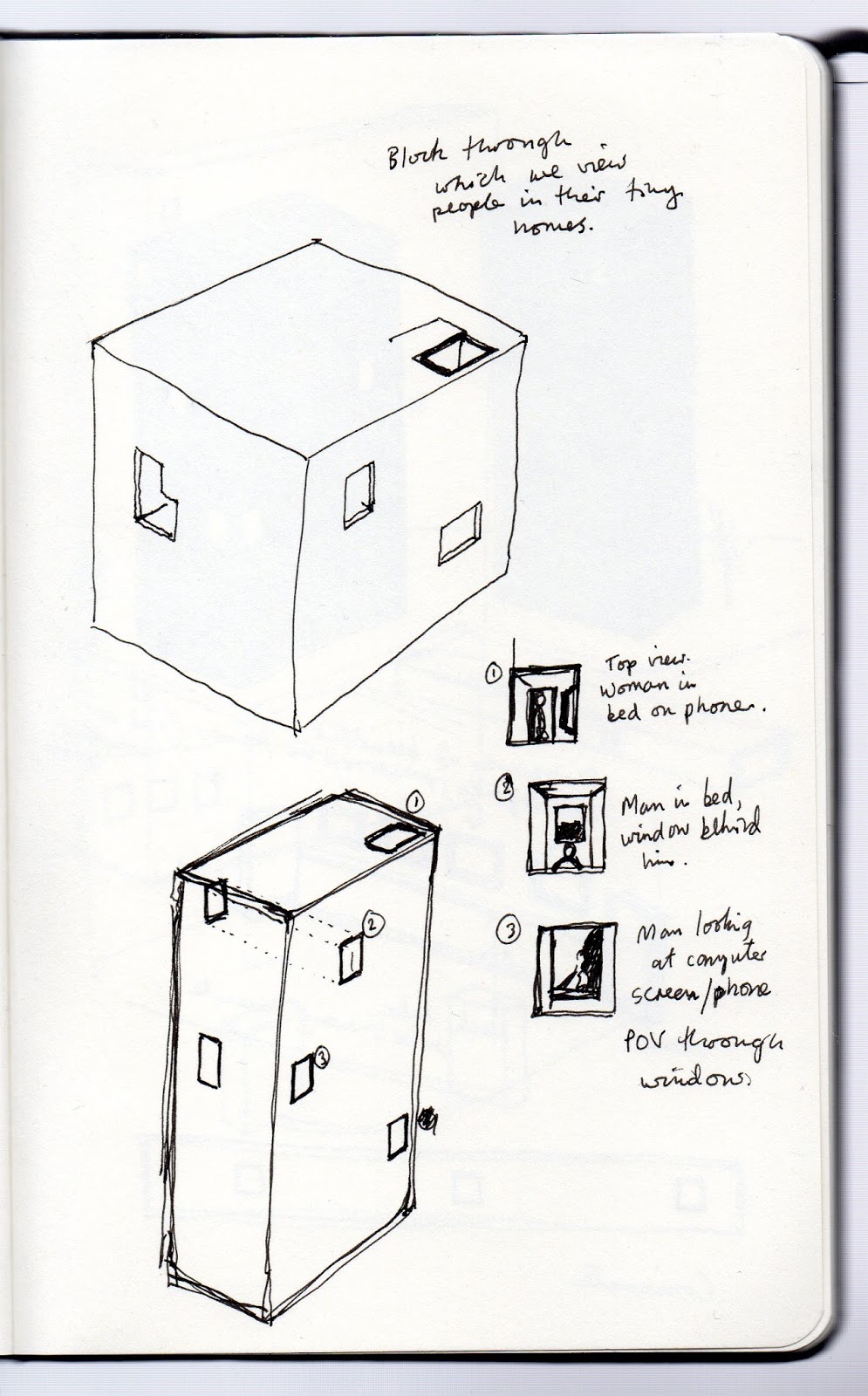
I have the idea of installing two blocks ('home' and 'work') with a tunnel representing the commute, inbetween. Photos of people inside their small spaces can be viewed through selected apertures or 'windows'. There is an additional idea of presenting larger photographs of the beauty of the outdoors, countryside, hills, forests etc which go by as we travel from one block to the other.

Detailed sketches of how the installation would look when set up in a gallery.

Monday, 9 May 2016

Tower Box

I have the working title 'Tower Box' in mind as it sits well with the form and shape of the box-like blocks containing small windows through which you will be able to view my photographs of box-like rooms.

In order to familiarise myself more with real-life blocks of flats I visited familiar areas of London, particularly the Shepherd's Bush - Holland Park border where I went to school. I always remember the area being flat, with tall structures rising at intermittent distances. Despite sticking out conspicuously into the skyline, they quickly became unnoticeable due to their familiarity and inconspicuous design. They loomed over me like sleeping giants.  


There is also Trellick Tower not so far away and can be seen clearly from the Westway, a location used by JG Ballard in his book 'Concrete Island'. I love Trellick Tower partly for its design but also for the way it acts like a homing device or landmark showing me how to get home. I saw it every day from the kitchen when I worked at the BBC and it made a great impression on me.

Trellick Tower as seen from the Westway. The theme of tower blocks and lines of travel are becoming more apparent in my work and ideas. 


Sunday, 8 May 2016

Michael Wolf's urban landscapes

Having read Kobo Abe's book 'Box Man' about a man who resigns himself to literaly living inside a box, I was drawn to Michael Wolf's series of photos 'The box men of shinjuku station'.

Michael Wolf's collections of urban photography are right up my street. By flattening the depth of field in photos from series' such as 'Architecture of density' and 'Paris rooftops' he highlights just how pressed together homes in urban spaces can be.

From 'The box men of shinjuku station'


From 'Architecture of density'


 From 'Paris rooftops'


The Box Man (2001) Kobo Abe


Wolf, M. (2005 - 2010) Life In Cities. http://photomichaelwolf.com/#

Abe, K. (2001) The Box Man. Vintage Books, London.


Thursday, 5 May 2016

Further progress - Tower Box

My idea is now returning to my original study and reserch into 'tower blocks' or 'high rise' buildings. I am continuing with the theme of isolation and living in small spaces but combining it with the bigger picture of thousands of isolated people living together (an oxymoron, I know, but that is the logic that fascinates me).

Thinking back to the Ai Weiwei exhibition I visited at the Royal Academy, his installation which had the freatest impact on me was the room full of small scale 'cells', replicas of rooms he had been confined and interogated. I was struck my the way he turned us, the audience, into voyeurs, peeking in through hatches to spy on the goings-on inside and in effect turning us into one of the guards. The reduction in scale made this possible, but the realistic rendition of the people and decor of the rooms made our voyeurism more pronounced.

 Ai Weiwei exhibition at the Royal Academy 2015


My plan is to now construct a model tower block, around 4fy high, with a selection of squares cut into them and photographs of rooms inserted. We will be able to view a few different rooms at different angles, for example one room viewed from the top would be like the 'small bedroom' I have already photographed from above.